HVAC guides
AC Running But Not Cooling: What to Check First
The blower is moving air, the outdoor unit sounds like it is working, and the house is still hot. That combination narrows it down considerably — and two of the four causes cost nothing to fix.
Short answer
A system that runs without cooling is failing to move heat out of the house. In order of likelihood: a blocked filter that has frozen the indoor coil, a condenser coil clogged with debris, a failed capacitor stopping the outdoor unit, or low refrigerant from a leak. The first two are free to check.
Start at the indoor unit
Two minutes here resolves a genuine share of calls.
Pull the filter out
Hold it up to a light. If you cannot see through it, that is very likely your answer. A restricted filter starves airflow across the evaporator coil, the coil temperature drops below freezing, and ice forms — and a frozen coil moves no heat at all. The classic pattern is a system that cooled fine for an hour and then stopped.
Look for ice on the copper line
Where the insulated copper line meets the indoor unit. Frost or a solid collar of ice confirms a frozen coil. Switch the system to FAN ONLY — not off — for two hours to thaw it, change the filter, then try cooling again. If it freezes again within a day, the cause is refrigerant rather than airflow and it needs a technician.
Check the thermostat is actually asking for cooling
Set to COOL, fan on AUTO, setpoint genuinely below room temperature. With the fan set to ON the blower runs continuously between cooling cycles, moving room-temperature air, which people reliably read as a failure.
Then go outside
The outdoor unit is where the heat is supposed to leave. If it cannot, nothing else works.
Is it running at all?
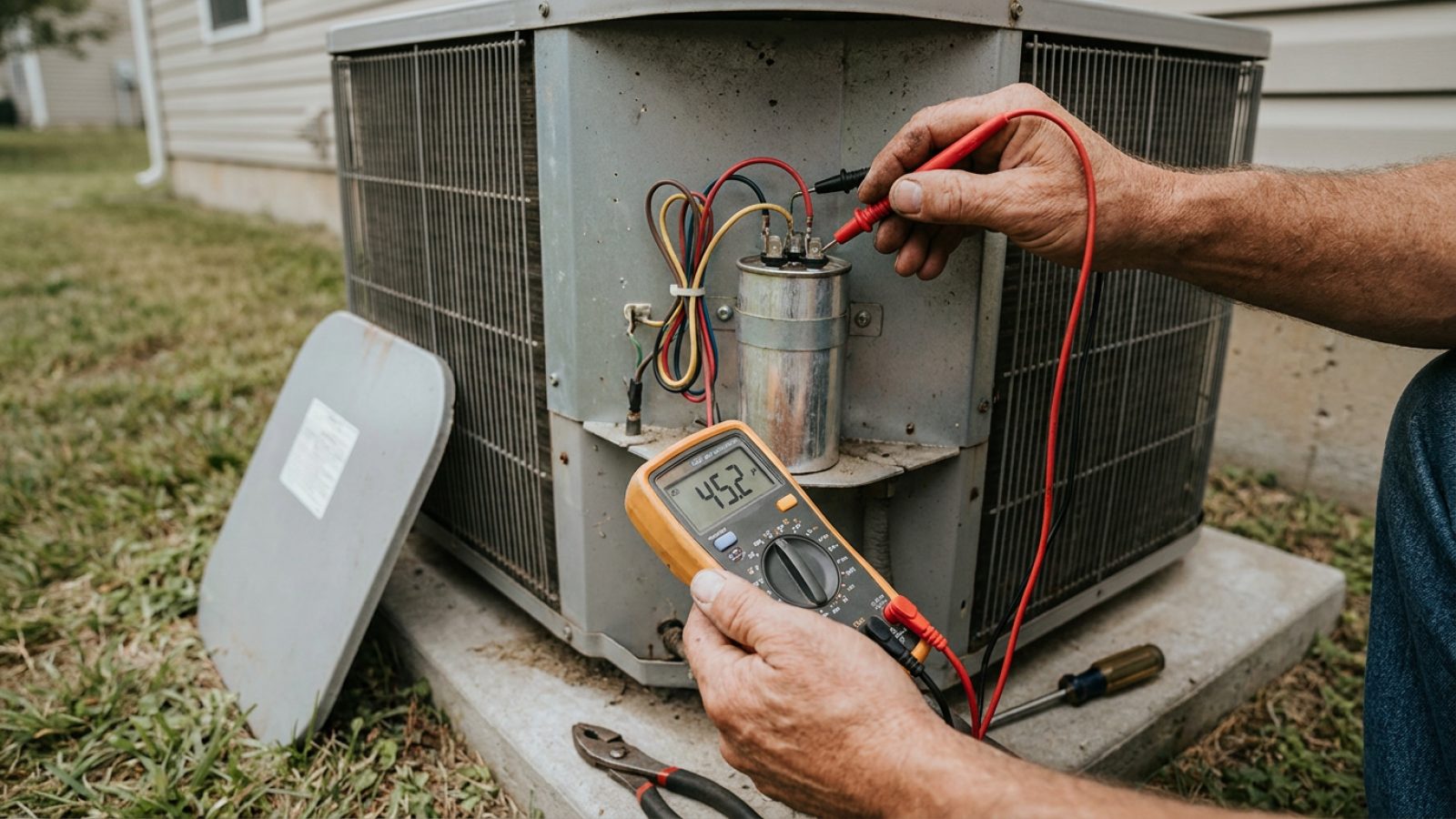
Fan spinning, compressor humming. If the indoor blower runs and the outdoor unit is silent, that is your fault located — a tripped breaker, a pulled disconnect, a failed capacitor or contactor, or a safety cutting it out. A unit that hums without the fan turning is the classic failed capacitor.
Is the coil clogged?
Late June is peak cottonwood season in New Jersey and the seed mats onto a condenser coil like felt. Grass clippings do the same. A blocked coil cannot reject heat, so the system runs constantly and never quite reaches setpoint. Switch off at the disconnect, then rinse the coil from the inside outward with a garden hose. Never a pressure washer — it folds the fins flat and makes it permanently worse.
Is there clearance around it?
Two feet all round, nothing growing into it, nothing stacked on top. Shrubs planted to hide the unit are a common and self-defeating cause.
What is left is a technician job
If the filter is clean, the coil is clear and the outdoor unit runs, two causes remain and both need equipment you do not have.
Low refrigerant, which means a leak
Refrigerant is not consumed — it circulates in a sealed system. A system that is low has a leak somewhere, and adding more without finding it is buying the same repair again next summer. Anyone who tops it up without proposing a leak search is selling a temporary result. Near the shore, corrosion is usually the underlying cause.
A failing compressor
The expensive one. Symptoms include the outdoor unit tripping the breaker on start, loud grinding, or a unit that runs but produces no temperature difference across the coil. On an older system this reopens the replacement question outright — and on an R-22 system it usually settles it.
The one that is not a fault at all
If the house reaches temperature quickly but feels damp and clammy, the system is very likely oversized rather than broken. It satisfies the thermostat before it has run long enough to remove humidity, so the air is cold and wet.
Turning the thermostat down makes this worse, not better. It is a sizing problem, and in New Jersey's humid summers it is the most common complaint after a badly specified replacement.
Need this done?
AC Repair across New Jersey
Free to use, no obligation — we never charge you.
Frequently asked questions
Why is my AC blowing warm air?
Check the fan is on AUTO rather than ON first. If it is, warm air usually means the outdoor unit is not running — a breaker, a capacitor, or a safety. Go and listen to it.
Can I add refrigerant myself?
No. Handling refrigerant requires EPA Section 608 certification, which is federal law. It also would not help: a low system has a leak, and overcharging causes its own expensive damage.
How long should it take to cool the house?
A correctly sized system lowers indoor temperature slowly and steadily — a degree or two an hour on a hot day is normal, not a fault. Systems that cool very fast are usually oversized and will leave the house humid.
Should I turn it off if it is not cooling?
If the coil is frozen, switch to FAN ONLY to thaw it rather than off entirely. If the outdoor unit is tripping a breaker, switch it off at the disconnect and leave it off until it is looked at.
HVAC services near you
- Trenton
- Newark
- Paterson
- Jersey City
- Hamilton
- Parsippany
- New Brunswick
- Camden
- Clifton
- Edison
- Elizabeth
- Princeton
- Tinton Falls
- Hopatcong
- Plainfield
- Red Bank
- Robertsville
- Sayreville
- Toms River
- Vineland