HVAC guides
Keeping HVAC Alive at the Jersey Shore
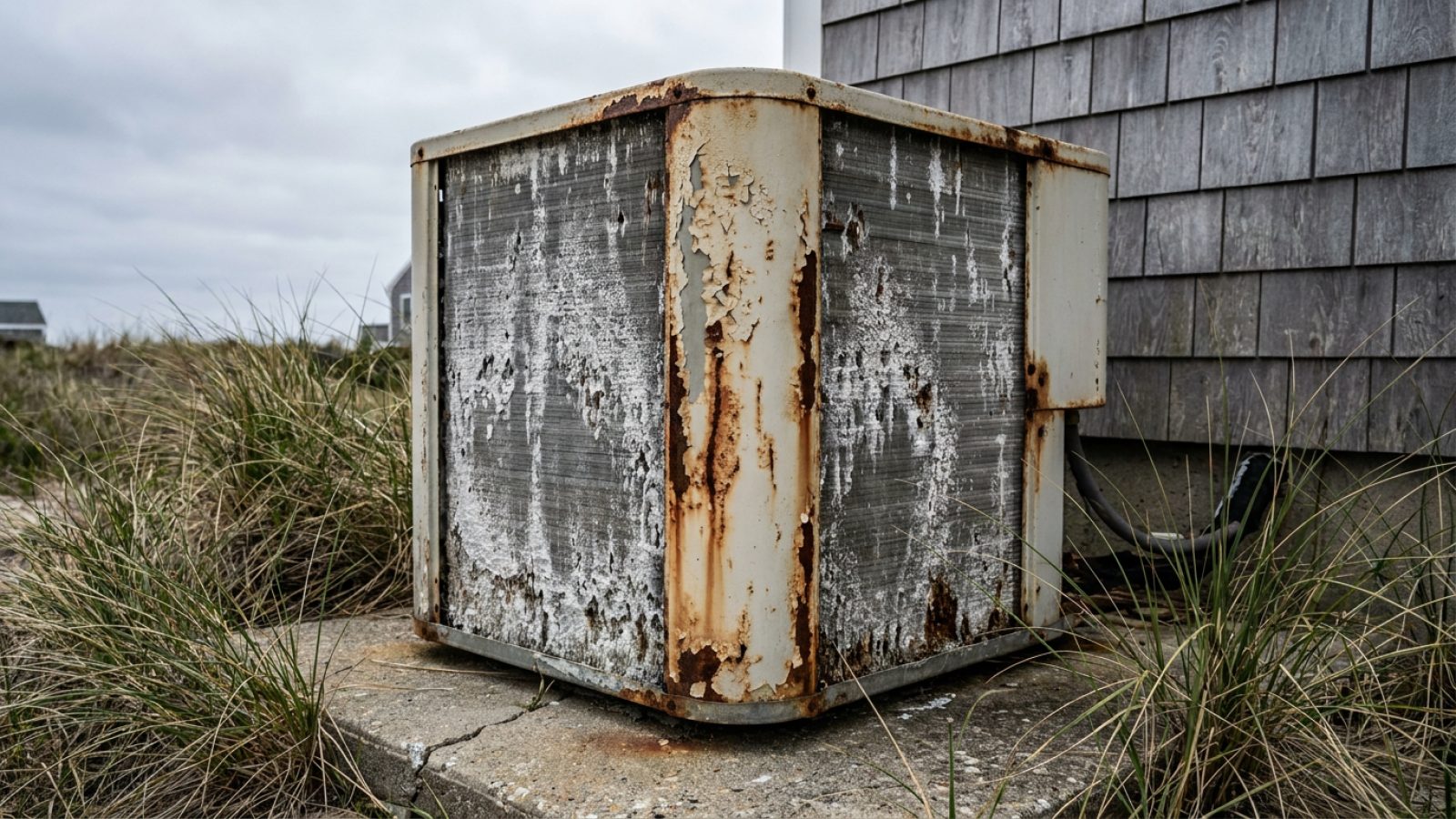
Equipment at the shore faces three things nothing inland does: salt in the air every day, eight months of sitting idle, and the possibility of standing in salt water. Each has a different answer.
Short answer
Shore condensers fail at eight to twelve years against fifteen-plus inland, almost always from salt corroding the coil. Freshwater rinsing several times a season, specifying a coated or all-aluminum coil at replacement, and never using a full wrap cover are the three measures that actually work.
Salt is the main event
Chloride in sea air attacks the aluminum fins and copper tubing of a condenser coil, concentrating at the joint between the two metals. It works continuously, and it works from the outside in — which is why a shore system can look perfectly sound and still be finished.
The failure presents as a refrigerant leak, because that is literally what it becomes when corrosion perforates the coil.
Rinse it, several times a season
The single most effective thing a shore homeowner can do, and it is free. Salt deposits sit on the fins and keep working; fresh water removes them. Switch off at the disconnect, then use a garden hose from the inside of the coil outward. Never a pressure washer — it folds the fins flat and does more damage than the salt would.
Specify the coil properly when you replace
Coated coils and all-aluminum microchannel designs — which remove the dissimilar-metal joint entirely — both resist chloride far better than standard construction. The uplift is small against replacing a system years early, and it is rarely the default on a quote unless the contractor works the shore routinely. Ask for it specifically.
Do not wrap it for winter
The most common well-intentioned mistake here. A fitted cover over the whole unit keeps rain out and humidity in, so the fins stay permanently damp and the salt already on them stays wet and active. It also makes an excellent rodent house. A top-only cover that leaves the sides open is fine; most manufacturers say no cover is needed at all.
Seasonal occupancy is the second problem
A house shut from October to May fails differently from one lived in year-round.
Things fail on the first hot weekend
Not gradually. A system that has not run since September is asked to work hard on Memorial Day weekend, and that is when capacitors, contactors and seized fan motors reveal themselves. It is also the worst weekend of the year to find a technician anywhere on the shore.
Book a start-up, not a mid-season service
The single most useful scheduling decision for a seasonal property: have the system started and checked in April or early May, before the season, rather than serviced at some point during it. It converts an emergency into an appointment.
Humidity while the house is closed
A shut house in a humid coastal summer grows mold. Leaving the system set to a high temperature — rather than off entirely — or running a standalone dehumidifier protects the interior, and costs far less than remediation.
Flooding and elevation
The third factor, and the one that changed after 2012.
Equipment that has been in salt water is finished
Not "should be checked" — finished. Salt water in an outdoor unit or an indoor air handler compromises electrical components, contactors and bearings even when it runs afterwards, and the failures arrive later. Have it assessed before it is powered up, and photograph everything for insurance before anything is moved.
Elevated mechanicals are now normal here
Flood rules changed after Sandy and a great deal of rebuilt shore equipment sits above grade — condensers on platforms, air handlers moved out of crawl spaces and into attics or upper floors. If you are replacing equipment in a flood-prone area, elevation is worth doing at the same time even where it is not strictly required, because the alternative is doing it after the next event.
Attic air handlers bring their own issue
Moving an air handler to an attic solves flooding and introduces condensate. A drain pan, a float switch and a secondary drain are not optional up there — a blocked primary drain over a finished ceiling is an expensive way to find out.
Need this done?
Coastal HVAC Corrosion Protection across New Jersey
Free to use, no obligation — we never charge you.
Frequently asked questions
How much shorter is HVAC life at the shore?
Commonly eight to twelve years against fifteen-plus inland, with a wide spread depending on how close you are, prevailing wind, and whether anyone ever rinsed the coil. A well-specified and rinsed coastal unit can beat a neglected inland one.
Should I cover my condenser over winter?
Not with a full wrap — it traps moisture against the fins and accelerates exactly the corrosion it is meant to prevent, as well as inviting rodents. A top-only cover is fine.
My system was flooded. Can it be dried out?
It should not simply be dried and restarted. Salt water compromises electrical components and bearings even when the unit runs afterwards. Get it assessed before powering up, and photograph everything for insurance first.
What should I do with a seasonal house over winter?
Leave the system set to a high temperature rather than off, or run a dehumidifier, to keep humidity down and mold out. Then book a start-up in April rather than discovering problems on the first hot weekend.
HVAC services near you
- Trenton
- Newark
- Paterson
- Jersey City
- Hamilton
- Parsippany
- New Brunswick
- Camden
- Clifton
- Edison
- Elizabeth
- Princeton
- Tinton Falls
- Hopatcong
- Plainfield
- Red Bank
- Robertsville
- Sayreville
- Toms River
- Vineland