HVAC guides
Living With Steam Heat in an Older New Jersey Home
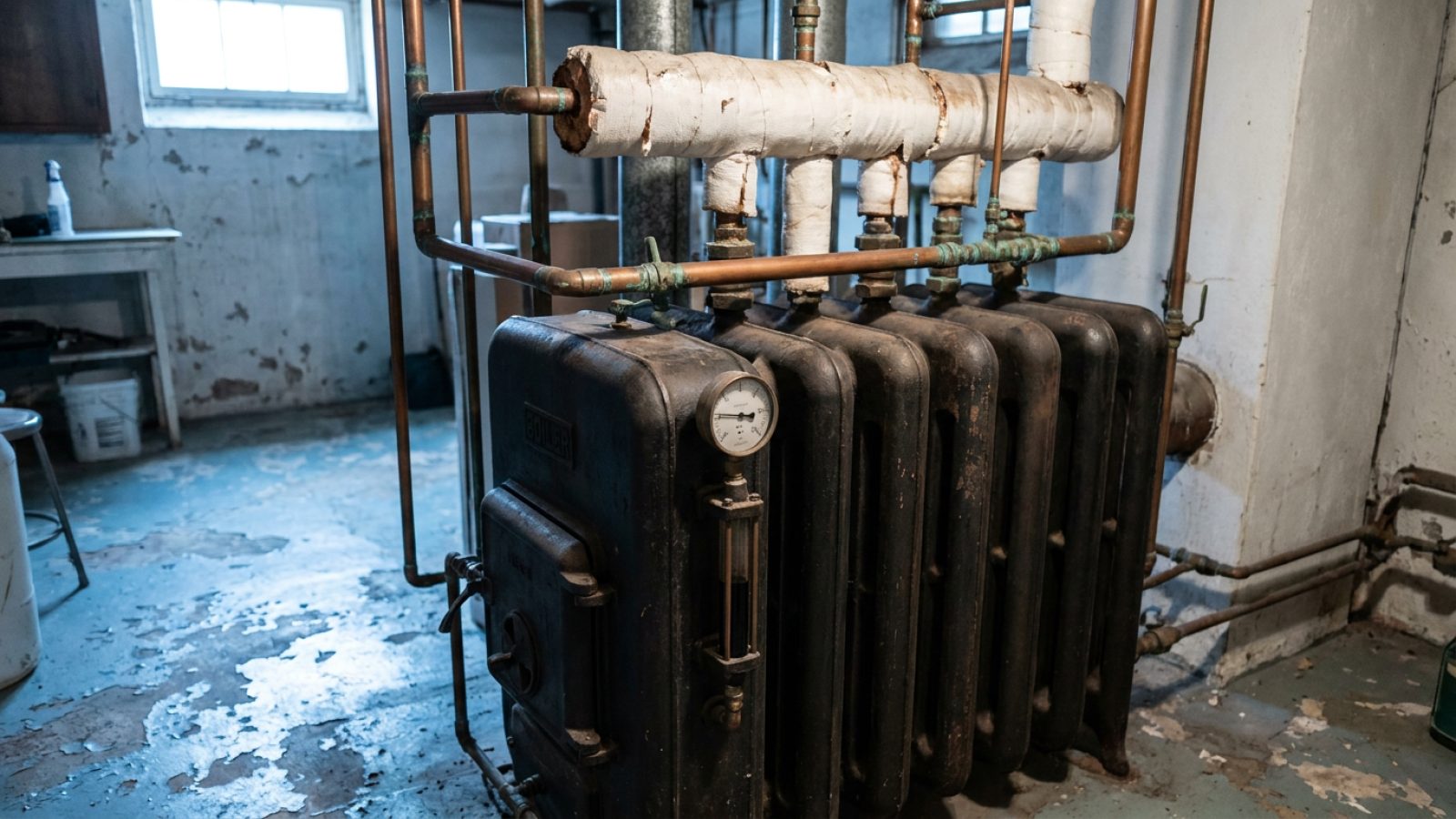
Steam heats a great deal of Hudson, Essex, Passaic and the older Trenton and Newark housing, and most complaints about it are misdiagnosed. The boiler is usually fine. The system around it is not.
Short answer
Uneven steam heat is almost always an air problem, not a capacity one. Steam cannot enter a radiator until the air already in it is pushed out, so failed or missing vents leave the far rooms cold. Banging is condensate trapped by a radiator that has lost its pitch. Neither is fixed by a bigger boiler or higher pressure.
How steam actually works, briefly
The boiler makes steam at very low pressure — ounces, not pounds. Steam is lighter than air, so it rises through the mains and into the radiators, pushing the air ahead of it and out through vents. When it hits the cool radiator it condenses back to water and drains back to the boiler by gravity.
Everything that goes wrong with steam is a variation on air not getting out, or water not getting back.
Why some radiators never heat
The single most common complaint, and the most commonly mistreated.
Main vents matter more than radiator vents
The large vents on the distribution mains in the basement do the heavy lifting — they clear the air out of the pipework so steam can reach the far end of the house at all. In a great many New Jersey buildings they are missing entirely, painted over, or seized shut. Fitting proper main venting is frequently the single most effective repair available on a steam system, and it costs far less than people expect.
Radiator vents are consumable
They fail closed, which starves that radiator, or open, which spits water and rust onto the floor. They are inexpensive and easily replaced. Adjustable vents let the system be balanced — slower vents on the near radiators, faster on the far ones, so steam arrives more evenly.
What does not fix it
Raising the pressure. Steam systems are designed to run under two pounds and many below one. Higher pressure does not push steam further — it makes venting harder, wastes fuel and stresses the system. A contractor whose answer to uneven heat is more pressure has misunderstood it.
The banging
Water hammer — the crack or bang that sounds like someone hitting a pipe with a wrench.
What is happening
Condensate has collected somewhere it cannot drain away, and incoming steam slams into it. The noise is the collision. It is not just unpleasant; over time it damages fittings.
Usually a radiator that has lost its pitch
Radiators must slope slightly back toward the supply pipe so condensate drains out. Floors settle, and floors get refinished — and the shims under a radiator get thrown away. Shimming it back to pitch frequently ends years of banging in an afternoon.
Sometimes a sagging main
If the banging is in the basement rather than at a radiator, a distribution main has sagged and is holding water. That is a hanger and pitch job on the pipework.
And sometimes wet steam from the boiler
If banging started after a boiler replacement, suspect near-boiler piping that does not follow the manufacturer diagram, so the boiler is carrying water into the mains. That is an installation defect and the installer's to correct.
What to check yourself, and what to leave
Steam rewards a small amount of owner attention.
The sight glass
The water level should sit around the middle and stay there. Constantly needing topping up means a leak somewhere. A glass so dirty you cannot read the level should be cleaned — it is your only window into the boiler.
Do not open radiator vents
They are not bleed valves. Unlike a hot water system, there is nothing to bleed, and opening one on a hot system vents steam at you.
Keep radiators clear
Furniture and covers over radiators cut output substantially. A radiator needs air moving across it to give up its heat.
Finding someone who actually works on steam
This is the practical difficulty. Steam is a specialism and a shrinking one — plenty of competent HVAC firms in New Jersey rarely touch it.
Ask directly how many steam systems they worked on last year. Ask whether they size from connected radiation rather than heat loss. If the first suggestion for uneven heat is a bigger boiler or more pressure, keep looking.
Need this done?
Boiler Repair across New Jersey
Free to use, no obligation — we never charge you.
Frequently asked questions
Why do my radiators bang?
Condensate trapped where steam wants to travel, almost always because a radiator or a main has lost its slope. Shimming a radiator so it drains back toward its pipe fixes a surprising number of cases.
Can I bleed a steam radiator?
No. Those vents are not bleed valves and there is nothing to bleed on a steam system. Opening one while the system is hot vents steam. Hot water radiators are different — those do bleed.
What pressure should my steam boiler run at?
Very low — generally under two pounds, and many systems run well below one. If yours is set higher because someone was trying to cure uneven heat, that is the wrong fix and it is costing fuel.
Is steam heat worth keeping?
Usually yes, in a house built for it. A well-vented, well-balanced steam system is comfortable and extremely durable, and converting to forced air means finding routes for ductwork that the house does not have. Fix the venting before considering replacement.
HVAC services near you
- Trenton
- Newark
- Paterson
- Jersey City
- Hamilton
- Parsippany
- New Brunswick
- Camden
- Clifton
- Edison
- Elizabeth
- Princeton
- Tinton Falls
- Hopatcong
- Plainfield
- Red Bank
- Robertsville
- Sayreville
- Toms River
- Vineland