HVAC guides
Keeping Wildfire Smoke Out of a New Jersey Home
June 2023 made this a New Jersey question rather than a western one. Wildfire smoke is fine particulate, which is exactly what filtration handles well — provided the filter suits the system it is fitted to.
Short answer
MERV 13 filtration captures a meaningful share of wildfire smoke particulate. The critical constraint is that a dense filter in a system not designed for the pressure drop restricts airflow and causes frozen coils and tripped limit switches. More filter area, not a denser one-inch panel, is the correct answer.
Why smoke is a filtration problem specifically
Wildfire smoke is dominated by very small particles — the fraction described as PM2.5, meaning under two and a half micrometers. That size is what makes it a health concern, because it penetrates deep into the lungs, and it is also what makes it filterable.
Gases and odor are a different matter and need carbon media rather than particulate filtration, which is why a house can smell faintly of smoke even after the haze has cleared.
Getting the filter right without breaking the system
This is where good intentions cause damage.
MERV 13 is the target
It captures a substantial proportion of PM2.5 while remaining practical for residential equipment. Lower grades let too much through; higher grades bring diminishing returns and rising pressure drop.
The mistake: a dense filter in a one-inch slot
Fitting a MERV 13 one-inch panel to a system designed around a cheap MERV 8 restricts airflow significantly. In summer the evaporator coil freezes; in winter the furnace overheats and trips its limit switch. People then conclude the system is failing when they have choked it.
The fix: more area, not more density
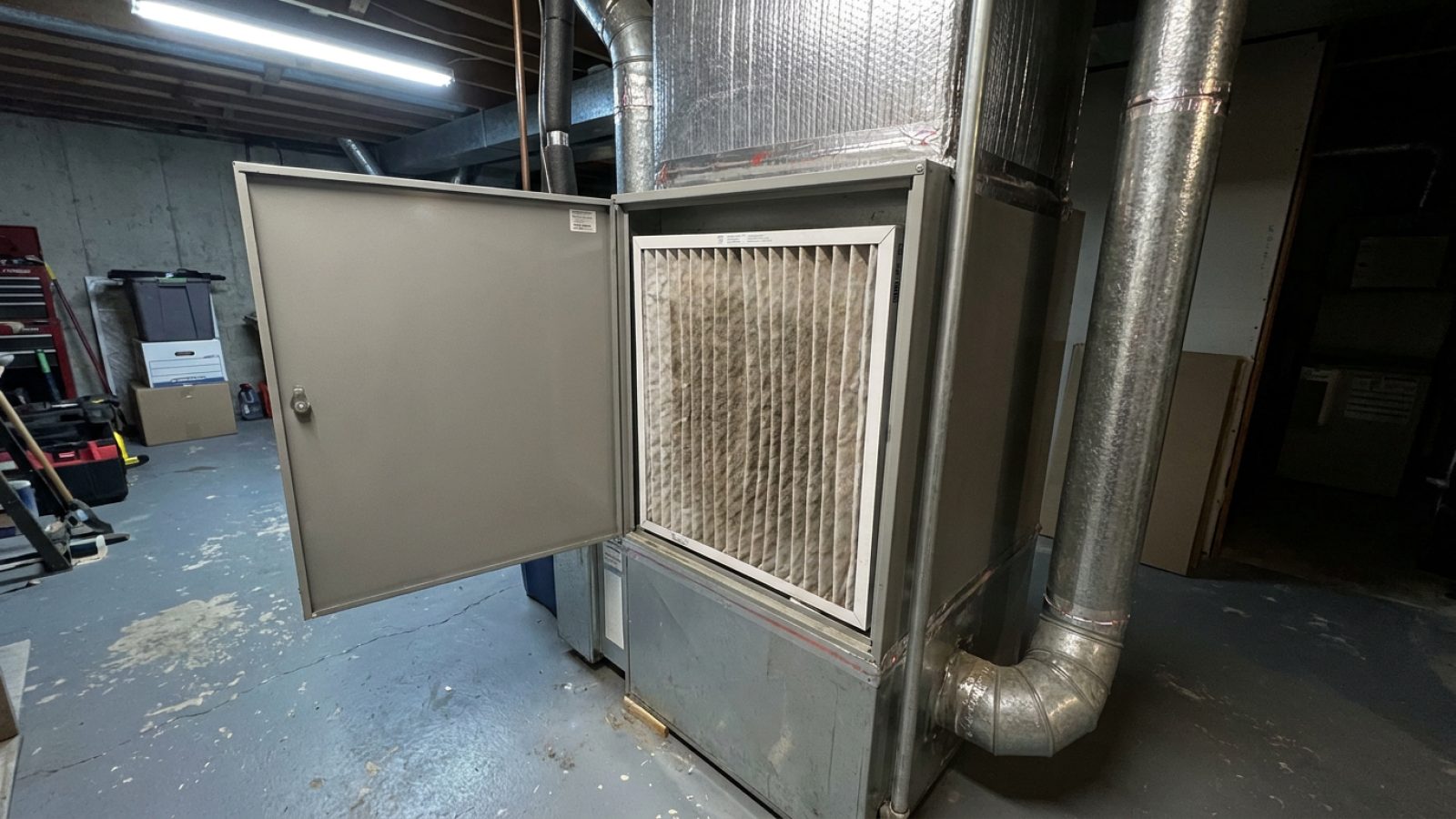
A four- or five-inch deep media cabinet holds far more filter surface, so it can be a higher grade while resisting airflow less than a dense thin filter. It is a modification to the ductwork at the air handler and it is the right way to run MERV 13 continuously.
Fit matters as much as grade
Air takes the easy path. A high-grade filter with gaps around the frame filters very little. A properly sealed MERV 8 outperforms a loose MERV 13 every time.
What to do during a smoke event
Short-term measures, for the days it actually matters.
Run the fan continuously
Switch the thermostat fan from AUTO to ON. The system then filters the air constantly rather than only while heating or cooling, which is exactly what you want when the outdoor air is bad. Switch it back afterwards.
Close the fresh air intake if you have one
Newer tighter houses sometimes have a ventilator bringing outside air in deliberately. During a smoke event that is working against you. Know whether you have one and how to close it.
A portable cleaner in the room you occupy
Frequently more effective than anything central, because it treats a small volume intensively. Size it to the room and run it in the bedroom overnight. Where the central system cannot take a high-grade filter, this is the practical answer.
Do not rely on window units to filter
Window and through-wall air conditioners have coarse washable filters intended to protect the coil, not to clean air. Some also draw outside air through a vent that may be open — worth checking it is closed.
What this shares with the everyday dust problem
If dust returns within days of cleaning, or smoke smell persists indoors after the air outside has cleared, the house is drawing unfiltered outside air in from somewhere.
In a ducted house that is usually return-side duct leakage, pulling air from an attic or crawl space. Sealing the return side does more than any filter upgrade — because a filter only cleans the air that passes through it, and leaked air bypasses it entirely.
Need this done?
Indoor Air Quality across New Jersey
Free to use, no obligation — we never charge you.
Frequently asked questions
What MERV rating do I need for wildfire smoke?
MERV 13 is the practical target for residential systems. The constraint is whether your system can take it — a dense one-inch filter restricts airflow badly. A deep media cabinet lets you run that grade safely.
Should I run the fan continuously during a smoke event?
Yes — switch the thermostat fan from AUTO to ON so the system filters constantly rather than only while heating or cooling. Switch it back afterwards, because continuous fan operation costs electricity and can affect humidity.
Do air purifiers actually help?
A well-sized portable unit in the room you occupy is genuinely effective, and often more so than central filtration because it treats a small volume intensively. Match the unit to the room size rather than buying on brand.
Why does my house still smell of smoke?
Particulate filtration does not remove odor or gases — that needs carbon media. It can also mean unfiltered outside air is getting in, commonly through return-side duct leakage in a ducted house.
HVAC services near you
- Trenton
- Newark
- Paterson
- Jersey City
- Hamilton
- Parsippany
- New Brunswick
- Camden
- Clifton
- Edison
- Elizabeth
- Princeton
- Tinton Falls
- Hopatcong
- Plainfield
- Red Bank
- Robertsville
- Sayreville
- Toms River
- Vineland